Free MCAT lesson
Dopamine: One Molecule, Every MCAT Section
Written by Shabari.
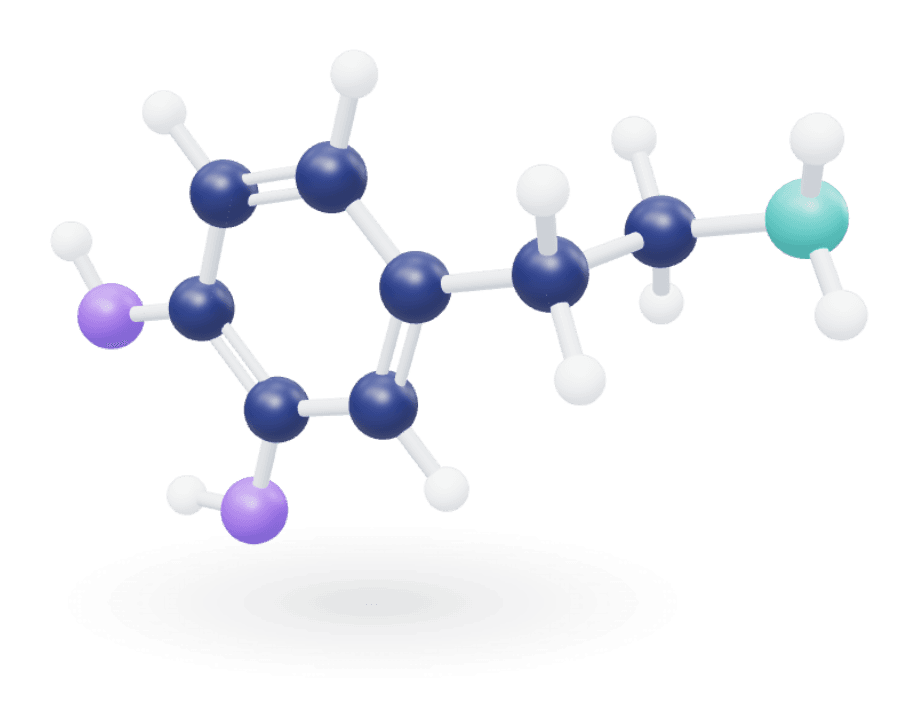
1What it is
Dopamine (C₈H₁₁NO₂) is a catecholamine: a catechol ring (benzene with two adjacent –OH groups) attached to an ethylamine side chain. It’s a neurotransmitter and the precursor to norepinephrine and epinephrine. Dopamine itself is achiral. Its amine (pKa ≈ 10) is protonated at physiological pH, so it carries a +1 charge and can’t cross the blood–brain barrier.
2How it’s made (catecholamine synthesis)
- Tyrosine → L-DOPA (tyrosine hydroxylase; rate-limiting; needs BH4)
- → dopamine (aromatic L-amino acid decarboxylase; needs vitamin B6/PLP)
- → norepinephrine (dopamine β-hydroxylase; needs vitamin C and copper; inside vesicles)
- → epinephrine (PNMT; uses SAM as a methyl donor; mainly in the adrenal medulla)
3How it’s cleared
Reuptake by the dopamine transporter (DAT), then breakdown by MAO and COMT. The main metabolite is homovanillic acid (HVA).
4Receptors
- D1-like (D1, D5): Gs-coupled → ↑ adenylyl cyclase → ↑ cAMP.
- D2-like (D2, D3, D4): Gi-coupled → ↓ cAMP.
5The four pathways
- Nigrostriatal: substantia nigra → striatum. Movement. Lost in Parkinson’s disease.
- Mesolimbic: ventral tegmental area (VTA) → nucleus accumbens. Reward and reinforcement; addiction. Overactivity linked to positive symptoms of schizophrenia.
- Mesocortical: VTA → prefrontal cortex. Motivation and executive function; underactivity linked to negative symptoms.
- Tuberoinfundibular: hypothalamus → pituitary. Dopamine inhibits prolactin release.
6Clinical connections
- Parkinson’s: patients get L-DOPA, not dopamine, because L-DOPA crosses the blood–brain barrier via amino acid transporters. Carbidopa blocks peripheral decarboxylation and doesn’t enter the brain, so more L-DOPA reaches it.
- Antipsychotics block D2 receptors: blocking nigrostriatal D2 causes movement side effects; blocking tuberoinfundibular D2 raises prolactin.
- Cocaine blocks DAT; amphetamine reverses DAT and releases dopamine. Both raise synaptic dopamine in the mesolimbic pathway.
7Psych/Soc connection: reward prediction error
Dopamine neurons fire for an unexpected reward. Once a cue predicts the reward, they fire at the cue instead. If an expected reward doesn’t come, firing dips below baseline. This is how dopamine teaches the brain what to expect, and it links to operant conditioning and addiction.
8Practice questions
Pick an answer to see the explanation.